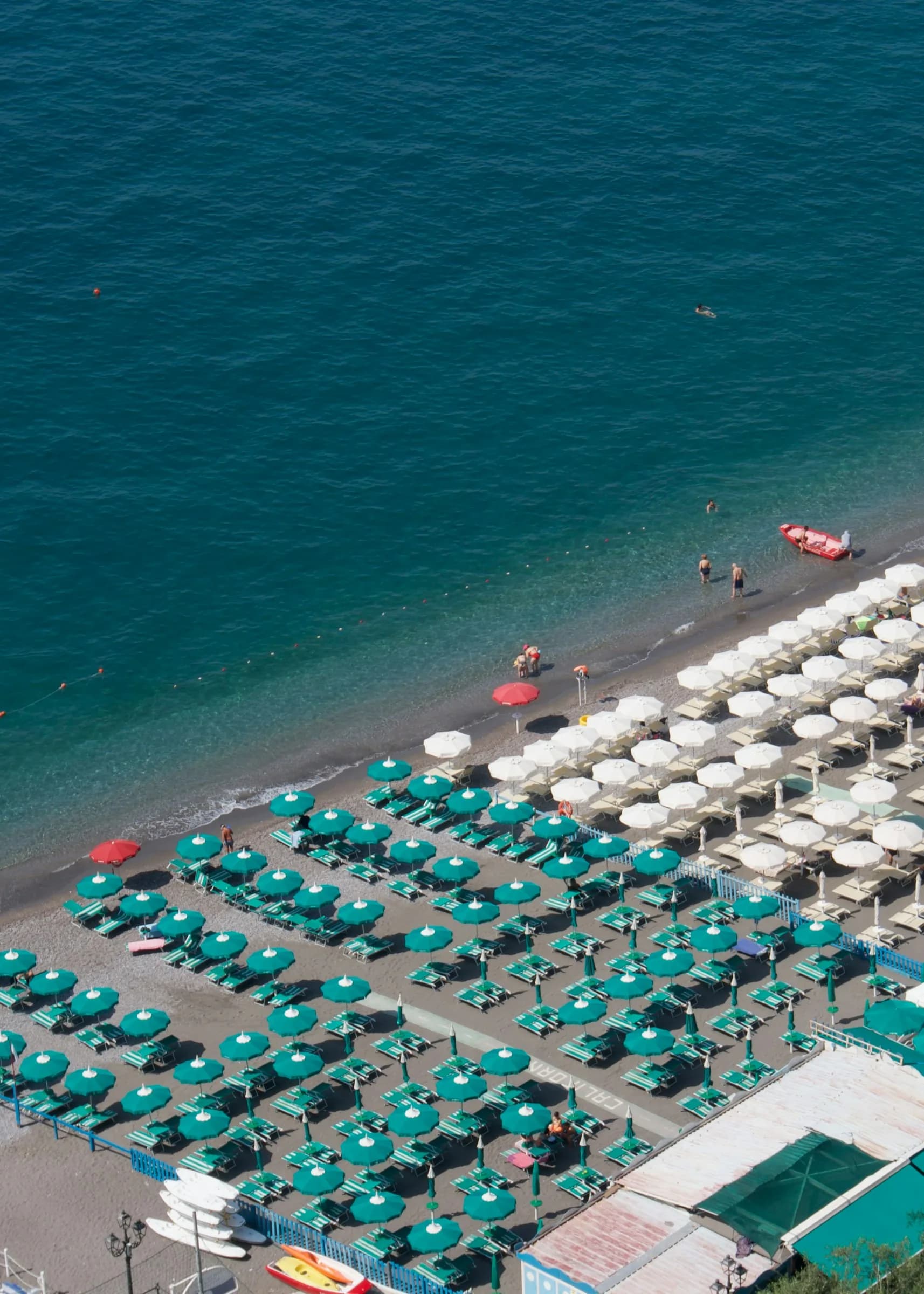
The Amalfi Coast’s beaches are not what most visitors expect. If you are imagining wide stretches of white sand, recalibrate now. Most beaches here are small coves of pebble, dark volcanic sand, or bare rock, wedged between dramatic limestone cliffs. Some require 300 stairs to reach. Others are accessible only by boat. Beach clubs dominate the prime waterfront and charge 15-50 euros per day for a sunbed. But free sections exist on almost every beach, the water clarity ranges from good to extraordinary, and the settings are unlike anything else in Europe. This guide covers every significant beach on the coast — honestly, with access details, costs, and the information you actually need.
Sand vs. Pebble: What to Expect
The first thing to understand about Amalfi Coast beaches is that most of them are not sandy in the traditional sense. The coast is made of limestone — the same rock that creates those dramatic cliffs — and when limestone erodes, it produces pebbles and gravel, not fine sand. The dark volcanic sand that does exist comes from historical eruptions of Mount Vesuvius, deposited along the coast over millennia.
Sandy beaches on the coast include Maiori (930 meters, the longest), Minori (250 meters, fine sand, south-facing), Spiaggia Grande in Positano (300 meters, dark volcanic sand), Cetara (coarse sand in the harbor), Erchie (pale sand, hidden hamlet), and La Baia in Vietri sul Mare (400 meters, wide and family-friendly). Castiglione (Ravello’s hidden beach) also has fine sand. These are your best options if you want a traditional beach experience with comfortable lounging.
Pebble beaches are the majority and include some of the most beautiful spots: Fornillo in Positano (quieter than Spiaggia Grande, crystal-clear water), La Gavitella in Praiano (the last beach to lose the sun each day), Arienzo in Positano (300 stairs, but rewarding solitude), Marina di Praia (a tiny fjord beach between enormous cliffs), and the Fiordo di Furore (dramatic gorge setting with emerald water). Pebble beaches often have clearer water because there is no sand to stir up.
The beaches you can only reach by boat are the quietest. Santa Croce near Amalfi (crystal-clear water, no facilities, reached by Coop Sant’Andrea shuttle for about 4 euros each way) and Laurito near Positano (home to Da Adolfo restaurant, free shuttle with lunch reservation) offer the most pristine swimming.
Practical advice: bring water shoes. Not the clunky rubber kind, but thin neoprene reef shoes that protect your feet on pebbles while still letting you walk naturally. They cost 10-15 euros and will transform your beach experience on the coast. A beach towel, sunscreen, and drinking water are essential for any beach without facilities.
The Best Beaches by Type
Best for families: Maiori Beach is the undisputed winner — 930 meters of sand, gentle slope into shallow water, playground on the lungomare, and it never completely fills even in August. Minori Beach (250 meters, fine sand, south-facing) is the alternative — calm, shallow, and backed by the pastry shops that keep kids happy. Erchie (hidden sandy cove near Maiori) is excellent for families who want something quieter. Castiglione near Ravello is a surprise: sandy, calm, and rarely crowded even in peak season.
Best for swimming and snorkeling: Santa Croce near Amalfi has the clearest water on the coast — crystal visibility, no crowds, and sea caves to explore with mask and fins. La Gavitella in Praiano has excellent snorkeling along the rocky sides of the cove. The Fiordo di Furore offers emerald-green water in a dramatic gorge setting. Spiaggia del Duoglio near Amalfi has outstanding snorkeling along the cliff base on its left side.
The quietest: Lannio Beach (a small sandy crescent before Cetara that most drivers pass without noticing; no facilities, no crowds), Santa Croce (by boat only), and Erchie (a hamlet with 20 residents, pale sand, medieval towers). These are the beaches that tourists who only visit Positano will never discover.
Best for sunset: La Gavitella in Praiano holds the record — it is the last beach on the coast to lose the sun each day, with a direct view toward Capri. The sunset turns the water gold. Arienzo in Positano also catches late-evening light. Fornillo Beach in Positano has good sunset views from its western end.
Best boat-access-only: The coast has several beaches reachable only by sea. Santa Croce near Amalfi (Coop Sant’Andrea shuttle, 4 euros each way) is the most pristine. Laurito near Positano (free shuttle with Da Adolfo reservation) combines food and beach. For the adventurous: rent a small gozzo motorboat (no license needed under certain engine power, about 80-120 euros per half day from Amalfi harbor) and explore the dozens of tiny coves that have no name and no people.
Best free beaches: Every town has a spiaggia libera (free public beach section). In Amalfi, it is the eastern end near the harbor. In Positano, the far left of Spiaggia Grande. Maiori has the most generous free sections along its 930-meter stretch. Atrani’s beach is mostly free. Cetara and Lannio are almost entirely free. The free beach in Erchie is substantial and rarely crowded.
Interactive beach map with all 22 beachesBest family beaches for kids
Free Beach Guide: Spiaggia Libera in Every Town
Italian law guarantees public access to the sea. Every beach on the coast has a designated spiaggia libera (free public section), even if beach clubs dominate the prime spots. Here is where to find free beach space in every town, from west to east.
Positano: The free section of Spiaggia Grande is on the far left as you face the sea. It is substantial but fills by 8:30 AM in July-August. Stake your spot early. Fornillo Beach has a free section between its two main lidos. Arienzo Beach (300 stairs) has an ample free section that is rarely crowded — the stairs deter most people.
Praiano: La Gavitella has a small free section. Marina di Praia has free space to the sides of the main beach club.
Amalfi: The free section of Marina Grande is at the eastern end near the harbor wall. It is the most reliable free spot in the area. Spiaggia del Duoglio (400 stairs down) has a free section to the right of the beach club. Santa Croce (boat-access only) is entirely free — no facilities, no charge.
Atrani: Most of the beach is free. It is the best value swimming experience near Amalfi — a 5-minute walk through the tunnel.
Minori: A generous free section occupies the center of the 250-meter beach, between the beach clubs on either end.
Maiori: The most generous free beach on the coast. Multiple large free sections alternate with beach clubs along the 930-meter stretch. Walk to the far eastern end for the quietest and most spacious free area.
Cetara: The beach is mostly free. Beach clubs are minimal. This is one of the few towns where the free section is bigger than the paid section.
Vietri sul Mare: La Baia has designated free sections with good space.
General free beach tips: bring your own umbrella and towel (no rentals on free sections). Arrive before 9:00 in summer for the best spots. Respect the boundaries — the line between free and paid sections is usually marked by colored flags or rope. Free sections have no shade, no sunbeds, and limited facilities. Carry water, sunscreen, and something to sit on.
Beach Club Culture: What to Expect
Beach clubs (lidi or stabilimenti balneari) are a fundamental part of Italian beach culture, and on the Amalfi Coast they range from modest to extravagant. Understanding how they work saves you from surprises.
How it works: You pay a daily rate for a set that typically includes two sunbeds (lettini) and an umbrella (ombrellone). This is your designated spot for the day. Most clubs also offer showers, changing rooms, and toilets. Many have a bar or restaurant on-site. You are not obligated to eat or drink there, but it is expected that you will at least order drinks.
Prices vary dramatically by location. In Positano: 30-50 euros per day for a basic set at Spiaggia Grande, up to 80-100 euros at the premium clubs with front-row positioning. In Amalfi: 20-35 euros. In Praiano (Marina di Praia): 15-25 euros. In Maiori and Minori: 15-20 euros. In Cetara and Vietri: 10-15 euros. These are per set (2 sunbeds + umbrella), not per person. Prices peak in August and drop 20-30% in shoulder season.
Reservations: In Positano and Amalfi, beach clubs fill early in summer. Some accept reservations; others operate first-come-first-served. For the popular clubs in Positano, arrive by 8:00 or call ahead. In Maiori and points east, reservations are rarely necessary — there is always space.
What to bring: Beach clubs provide the basics but not everything. Bring your own sunscreen, reading material, and water shoes (even club beaches can have pebble entry). Some clubs provide towels; most do not. Wearing only swimwear is fine within the beach club area but cover up when walking through town.
The premium experience: some beach clubs offer full restaurant service at your sunbed, cocktail bars, DJ sets in the afternoon, and Instagram-ready settings. Da Adolfo in Positano is a beach club and restaurant, reached only by its free boat shuttle from Spiaggia Grande (look for the red fish on the mast). The Africana Famous Club at Marina di Praia is a nightclub carved into a sea cave that also functions as an atmospheric beach bar during the day.
Budget alternative: Skip the clubs entirely. Use the free beach sections, bring your own gear, and spend the 30-50 euros you save on an excellent seafood lunch at a local trattoria. The sea is the same.
Beyond the Coast: Marine Reserves and Island Beaches
The waters around the Amalfi Coast include protected marine areas with some of the clearest water and richest marine life in the Tyrrhenian Sea. These make exceptional day trips for snorkeling, swimming, and experiencing a wilder side of the coast.
Baia di Ieranto, near Nerano on the Sorrentine Peninsula, is the sacred tip of the coast facing Capri’s Faraglioni rocks. The bay is a marine reserve managed by FAI (Italy’s National Trust). A 2-kilometer trail from the village of Nerano through Mediterranean scrub leads to a pristine bay with water so clear the seafloor is visible at 10-meter depth. Greek and Roman temples once stood here. There are zero facilities — bring everything: water, food, sun protection, snorkeling gear. The trail is exposed to sun, so avoid midday in summer. This is one of the most beautiful swimming spots in the entire Mediterranean.
Punta Campanella Marine Reserve lies at the tip of the Sorrentine Peninsula. An ancient temple to Athena once crowned the promontory. The marine reserve protects rich underwater ecosystems including Posidonia oceanica meadows, coral formations, and abundant fish life. Snorkeling here is extraordinary. The hike from the village of Termini takes about 40 minutes through Mediterranean scrub. No facilities at the point — total self-sufficiency required.
Li Galli Islands (the Sirenuse) sit off the coast between Positano and Capri. Homer’s sirens supposedly sang here. The three small islands are private property (once owned by dancer Rudolf Nureyev), so you cannot land, but the swimming in the waters around them is extraordinary. Most boat tours from Positano and Amalfi include a Li Galli swimming stop. The water is crystal clear and deep blue.
For the best snorkeling, combine a boat rental (gozzo from Amalfi or Positano, 80-120 euros per half day, no license needed for small engines) with visits to the base of cliffs between towns. The stretch between Amalfi and Conca dei Marini has sea caves, underwater rock formations, and visibility that reaches 15-20 meters on calm days.
The tip
The Grotta dello Smeraldo (Emerald Grotto) near Conca dei Marini is accessible by boat from Amalfi (Coop Sant’Andrea, 10 euros return, April-October) or via stairs from the SS163. Visit between 12:00 and 14:00, when the green reflections are strongest.
Day trip options including Capri and islandsAll hiking trails on the coast
Questions
Do I need water shoes on the Amalfi Coast?
Highly recommended. Most beaches are pebble or have rocky entry points. Thin neoprene reef shoes (10-15 euros) protect your feet while still letting you walk normally. You can buy them at beach shops in any town.
Are beaches free on the Amalfi Coast?
Every beach has a free public section (spiaggia libera) by law. However, beach clubs (lidi) dominate the best spots and charge 15-50 euros per day for sunbeds and umbrellas. The free sections are smaller and have no shade or facilities. Maiori, Cetara, and Atrani have the most generous free beach areas.
What is the best beach for families on the Amalfi Coast?
Maiori Beach: 930 meters of sand, gentle slope, shallow water, playground, and it never fills completely. Minori Beach is the runner-up with 250 meters of fine sand. Both have full facilities and affordable beach clubs (15-20 euros per day).
Can I bring food and drinks to the beach?
On the free beach sections (spiaggia libera), absolutely — bring whatever you want. At beach clubs, you are expected to buy drinks and food from them. Bringing your own cooler to a beach club would be frowned upon, though no one will stop you from having a water bottle.
When is the best time for beach weather on the Amalfi Coast?
The sea is warmest in September (25-26 degrees) after absorbing heat all summer. June through October offers comfortable swimming. July-August have the hottest air temperatures (30-35 degrees) but also the biggest crowds. Late September offers warm sea, fewer people, and golden light.